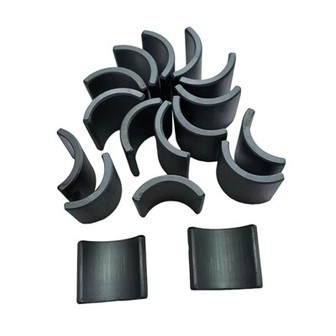
Secrets To DC Motor Magnet Placement
Sep 02, 2025
Basic Principles of Magnet Placement
DC motor magnets aren't placed randomly! Like dancers, they must maintain precise positioning:
- Alternating Polarity: Adjacent magnets must alternate their north and south poles to form a closed magnetic field loop.
- Symmetrical Distribution: All magnets must be evenly spaced at equal angles to ensure balanced forces on the rotor.
- Air Gap Control: Maintain a 0.5-2mm gap between the magnets and the rotor. Too close will cause friction, while too far will weaken the magnetic field.
- Special Layout of Four Magnets: When a motor uses four magnets, a classic "cross" magnetic field is formed:
- 90-degree Equal Division: Each magnet is installed 90 degrees apart, like the 3/6/9/12 o'clock positions on a clock.
- Poles Pairing: Magnets on a diagonal line have the same polarity (e.g., both 3 and 9 o'clock have north poles).
- Magnetic field superposition: Adjacent magnetic fields of opposite polarity form a strong interaction zone at the center, driving the rotor.
- The butterfly effect of placement errors: A slight error can lead to a huge difference. Magnet misalignment can trigger a chain reaction:
- Increased vibration: A 1mm misalignment can cause speed fluctuations exceeding 10%.
- Reduced efficiency: A 5-degree angular deviation can reduce torque output by 8-12%.
- Double noise: Asymmetrical magnetic fields produce a harsh electromagnetic buzzing sound.
- Shortened lifespan: Long-term uneven loads can cause bearings to retire prematurely.
Previous: How To Arrange DC Motor Magnets?