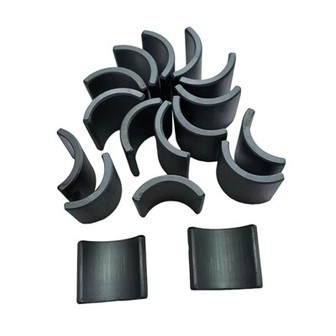
The Role and Technological Trends of Automobile Fan Motor Magnet
As the automotive industry moves toward higher efficiency and intelligent systems, vehicle thermal management has emerged as a core technical domain. Among the many components that enable effective heat dissipation, the Automobile Fan Motor Magnet plays a crucial role in ensuring stable and efficient operation of cooling fan motors, which are essential in engine cooling systems, air conditioning units, and battery thermal control systems.
The function of an Automobile Fan Motor Magnet is to generate a stable magnetic field that drives the fan motor, enabling airflow necessary to maintain optimal temperatures within the vehicle's systems. Unlike stationary industrial motors, automotive cooling motors are subject to frequent start‑stop cycles, temperature fluctuations, vibration, and exposure to moisture. Therefore, the magnet must maintain consistent magnetic performance under these demanding conditions to ensure reliable operation over long service periods.
Material selection is a fundamental aspect of magnet performance. Ferrite magnets are often chosen for their thermal stability and cost efficiency, making them suitable for high‑temperature environments typical of automotive cooling systems. On the other hand, neodymium iron boron (NdFeB) magnets offer much higher magnetic energy and flux density, enabling smaller motor designs with higher torque and improved efficiency. In applications where compact size and performance are critical, NdFeB magnets can significantly enhance motor capabilities.
Precision in manufacturing the Automobile Fan Motor Magnet is equally important. Parameters such as dimensional tolerance, magnetic uniformity, and magnetization direction must be strictly controlled. Even minor deviations in magnet geometry can lead to uneven magnetic fields, resulting in noise, vibration, or reduced motor performance. Advanced CNC machining and rigorous quality control systems are therefore essential to producing magnets that meet automotive standards.
Looking forward, the evolution of automotive thermal management, especially in electric vehicles, is driving further innovation in magnet design. Optimizing material formulas, refining magnetic circuit structures, and implementing temperature compensation techniques are all part of the trend toward higher performance, lower energy consumption, and more intelligent control. As a result, the Automobile Fan Motor Magnet will continue to play a pivotal role in improving vehicle efficiency, system reliability, and overall driving comfort in next‑generation automotive platforms.